

- One-to-one: Each external transaction is matched with exactly one internal transaction.
- One-to-many: Each external transaction is matched with one or more internal transactions.
- Many-to-one: One or more external transactions are matched with exactly one internal transaction.
Choosing a strategy
Pick the strategy that best reflects how money groups or splits between your ledger and your external source.- If nothing is split or combines, use one-to-one, e.g. a customer pays $25 with their card; your ledger records a $25 transaction and your processor statement also shows a single $25 charge.
- If one record on the external side triggers multiple records on the internal side, use one-to-many, e.g. A payment processor reports a single $100 charge, but your ledger records it as separate entries for the gross amount, the processing fee, and the net amount deposited.
- If multiple records on the external side and combined into one record on the internal side, use many-to-one, e.g. a processor reports a transaction in multiple parts, for example fee breakdowns or split authorizations, but your ledger stores it as a single $120 charge.
Applying your strategy
To apply your strategy, select it from theStrategy dropdown field when creating a new reconciliation run.
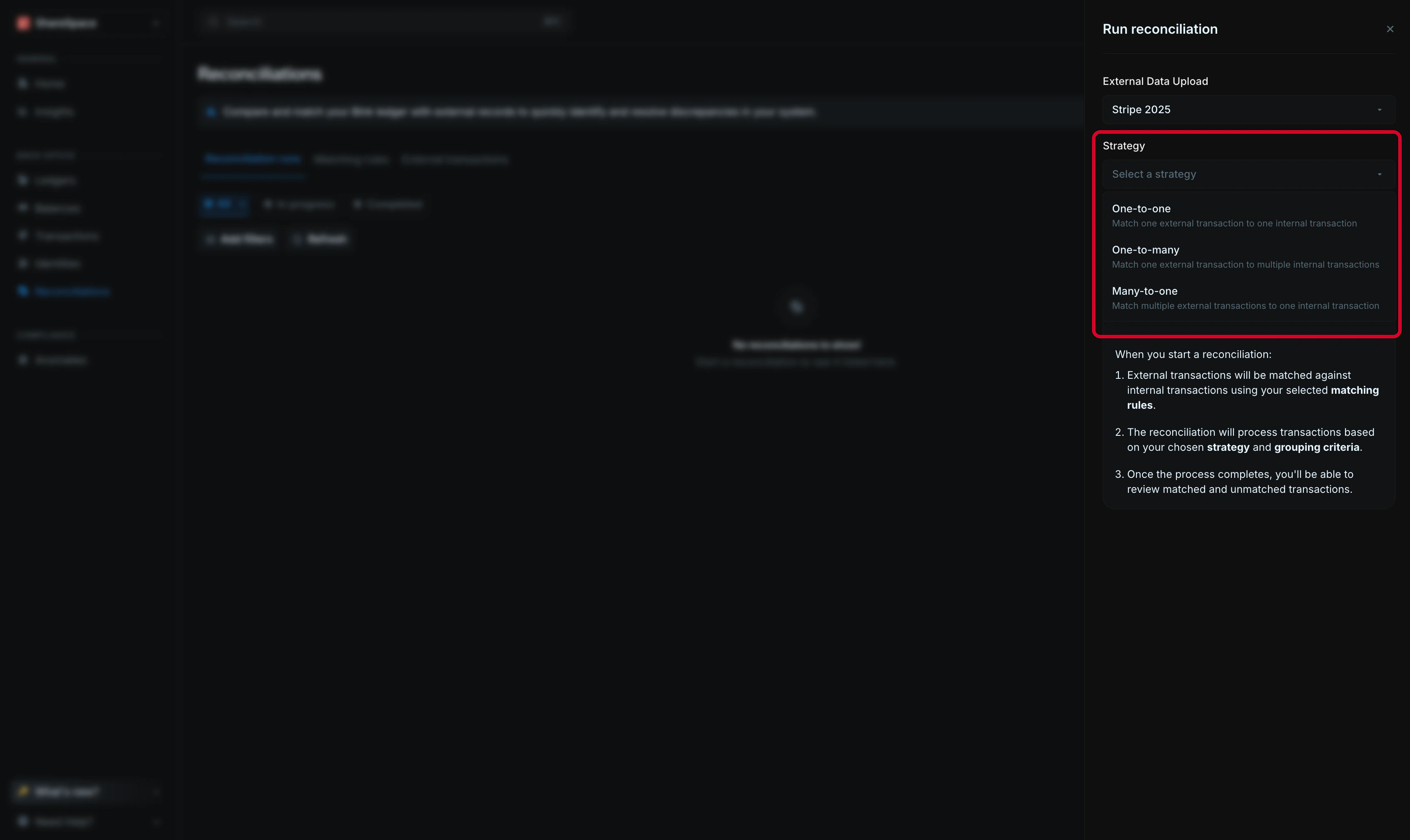
grouping criteria.
This field determines how Blnk groups the records on the many side for reconciliation. Here are the available grouping options for each strategy:
-
One-to-many:
-
Many-to-one:
Grouping criteria is not required for one-to-one strategy.