

- Centralized authentication. Access multiple Core instances (dev, staging, production) through a single endpoint.
- Deployments. Deploy a ledger as a managed Core instance, then manage it from your workspace.
- Audit logging. Every API call is logged in your workspace for compliance and debugging.
- Data lake. Run custom, advanced insights SQL against your ledger instance via Data Lake.
- Real-time alerts. Set up programmable alerts to notify you on your workspace when something happens in your integration.
- AI integrations. Implement AI back-office workflows with our MCP and Agents API.
- Billing. Read plan status, invoices, and record usage, or opt into usage-based billing.
How Cloud APIs work
Cloud APIs act as an intelligent layer between your application and your Blnk Core instances. They do not replace the Core API, but rather provide a more convenient way to interact with your Core instances. Suppose you’re building an internal dashboard to manage multiple Blnk Core instances, such as staging and production. A straightforward approach is to store each instance’s credentials in your server’s .env and have your dashboard’s backend call the appropriate instance directly. But connecting to each instance is only part of the work. Once your team starts using the dashboard, you also need to know who did what, when, and on which instance. That means building and maintaining auth and audit logging from scratch and making sure every action is recorded against the right user and environment. Using Blnk Cloud APIs changes this. Your internal tool can use Cloud’s instance management and audit logging APIs instead to manage access to your Core instances. Here’s a simple demonstration:1
Connect your Core instances
Connect each of your Core instances to your Blnk Cloud workspace. Each connected instance gets an
instance_id; this is all you’ll need to interact with the instance moving forward.2
Create Cloud API keys
For each user in your internal tool, create a Cloud API key. This key will be used to authenticate the user when they make API calls to your Core instance.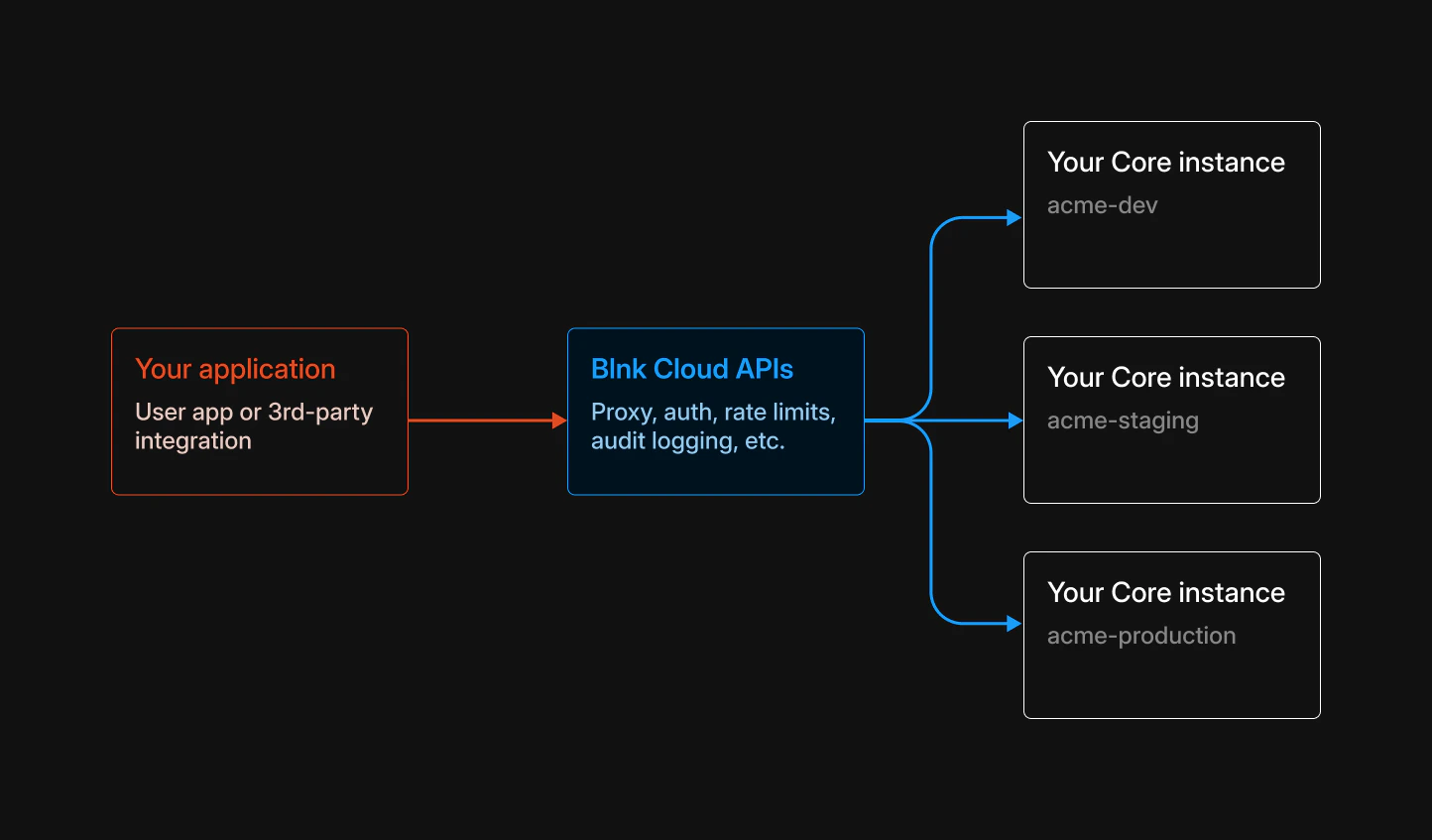
Cloud API keys are not the same as your Blnk Core API keys. If calling the Core API directly, you’ll need to set up your API keys directly in Core.
3
Integrate using the Cloud Proxy API
Retrieve data, create resources, etc. using the Cloud Proxy API, authenticated with your user’s Cloud API key.Suppose your user refunded a transaction on your production instance.
- With Cloud APIs
- Without Cloud APIs
Request is made via the Cloud Proxy, your user is authenticated and their actions are logged in your workspace. The request is then routed to the appropriate Core instance.To see your user’s actions in the audit log, navigate to the Audit log tab in your workspace, or query using List audit logs.
cURL